
Anchor link: this is the front-end protection for our tenant placement service.
We view a thorough tenant screening process as the most critical 24 hours of the property management lifecycle. Getting this initial assessment right eliminates the majority of operational headaches for the next two years.
Our team at Durham Elite Property Management understands that a single bad placement can drain thousands of dollars from your budget. A typical eviction in 2026 costs landlords an average of $3,500 to $10,000 in lost rent and legal fees.
We created this guide to explain exactly how to build a reliable defense against these losses.
Let’s look at the data and explore the practical actions you can implement today.
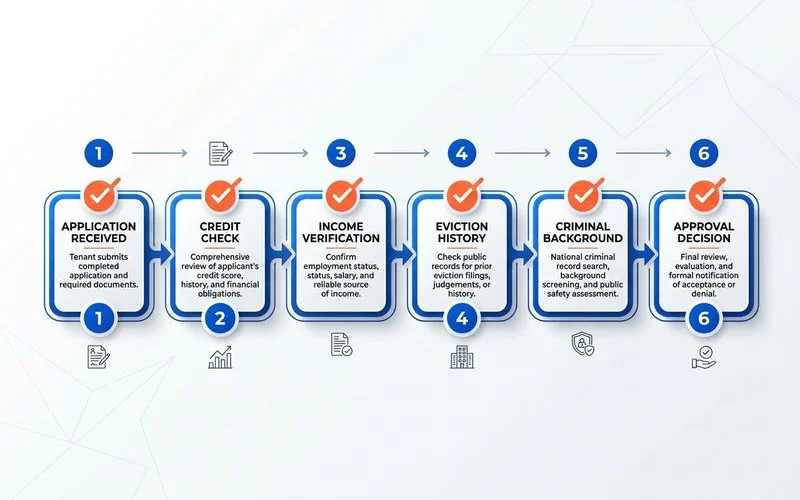
The Six-Step Tenant Screening Process Pipeline
Our six-step screening protocol moves from basic identity verification through deep financial and behavioral checks. This systematic approach ensures a reliable placement every time.
Step 1: Application Intake and ID Verification
We begin with a secure online application requiring mandatory disclosures and clear consent for background checks. The National Multifamily Housing Council reported in early 2026 that 93.3% of landlords experienced rental fraud in the past 12 months.
Our staff strictly verifies every government-issued photo ID against the submitted application data to catch inconsistencies immediately. Tools like Snappt help property managers flag manipulated pay stubs before a lease is ever signed.
Step 2: Equifax Credit Pull
We pull a full Equifax credit report to check for bankruptcies, judgments, and specific rental-screening signals. The national average tenant credit score currently sits at 650 according to 2026 housing data.
Our firm looks closely at three major financial warning signs:
- High revolving credit utilization
- Outstanding utility or housing collections
- Recent bankruptcy filings
A rigid numerical baseline of 635 removes emotion from the approval process. We explain the exact reasoning behind this standard in our Tenant Credit Score and DTI Requirements in NC guide. This specific target score reliably separates standard applications from truly excellent ones.
Step 3: Income and Employment Verification
Our standard procedure involves a live employer call to confirm the applicant’s position, tenure, and current income. Fraudsters frequently purchase fake employment letters online for just a few dollars.
We thoroughly review consecutive pay stubs for mathematical consistency and correct tax deductions. Calculating the Debt-to-Income ratio provides a clear picture of an applicant’s true financial health.
Our team divides the total monthly debt obligations plus proposed rent by the gross monthly income. Setting a strict 55% maximum DTI limit prevents tenants from becoming financially overextended.
Step 4: Eviction History Check
We run a comprehensive national database search to identify any filed evictions over the past seven years. Eviction proceedings easily cost owners upwards of $3,500 in lost rent and legal fees.
Our management policy dictates absolute zero tolerance for prior evictions of any kind.
“Evictions represent the single largest financial threat to independent landlords, making thorough front-end screening absolutely non-negotiable.”
Past behavioral patterns serve as the single most accurate predictor of future non-payment issues.
Step 5: Criminal Background Check
We conduct an individualized assessment of criminal history under strict HUD guidance. Federal regulations dictate that landlords cannot deny applicants based solely on arrest records without actual convictions.
Our tenant background check process evaluates the nature of any conviction, the time elapsed, and its direct relevance to property safety. Blanket bans on all criminal history expose property owners to disparate-impact claims under North Carolina and federal fair housing laws.
Step 6: Prior-Landlord References
Our staff personally calls the two most recent landlords to gather genuine behavioral insights. Credit reports cannot tell you if a tenant consistently disturbed neighbors or left a property completely trashed.
We ask specific questions regarding three critical areas:
- Timely rent payments
- Full lease fulfillment
- Property condition upon move-out
This live conversation remains the most diagnostic and revealing step in our entire pipeline.
What Each Step Catches
We utilize a specific matrix to identify distinct risk categories during the review process. The table below outlines exactly how tenant screening works in practical terms and what each phase of the pipeline uncovers to protect your investment.
| Screening Step | Specific Risk Caught |
|---|---|
| Equifax credit pull | Default risk and hidden financial judgments |
| DTI calculation | Late-rent probability on tight monthly incomes |
| Eviction history check | Repeat-offender patterns and costly legal risks |
| Criminal background | Tenancy-relevant safety risks to the community |
| Prior landlord call | Destructive behavioral patterns credit scores miss |
| Employment verification | Doctored pay stubs and completely fake employers |
We frequently see independent owners rely entirely on basic DIY consumer tools like TransUnion SmartMove or Zillow Rental Manager. These platforms provide standard credit data but completely miss the live employment verification and FHA-compliant criminal assessment.
Our team handles the crucial prior-landlord conversations that automated systems skip. You can review our comprehensive Self vs Professional Tenant Screening guide for a detailed side-by-side comparison.
NC Fair Housing Compliance
We strictly apply all screening criteria uniformly to every single applicant to ensure total legal compliance. The Fair Housing Act protects individuals based on race, color, national origin, religion, sex, familial status, and disability.
Our established baseline criteria applied to every applicant includes the following non-negotiable standards:
- A confirmed 635 minimum credit score.
- A verified 55% maximum Debt-to-Income ratio.
- A zero-tolerance policy for prior evictions or relevant criminal safety risks.
Written approvals and denials keep your operations legally sound. We document every single decision clearly to provide denied applicants with a rationale tied directly to one of these stated criteria.
Inconsistent application of rules is the fastest way for an independent landlord to face a discrimination lawsuit. Our firm avoids disparate-impact exposure by never accepting one applicant with a 615 credit score while rejecting another with the identical score.
Documented criteria applied uniformly forms the absolute legal baseline for property management. We strongly encourage you to review the Common Tenant Screening Mistakes That Get NC Landlords Sued to understand these common legal traps.
Total Turnaround
We typically complete the entire approval process within 24 hours of receiving a complete application. This rapid turnaround depends heavily on prompt responses from employers and past landlords on the same business day.
Our staff quickly moves to lease preparation, deposit collection, and move-in scheduling to secure the tenant once the rental application screening steps are finalized. Finalizing these placement logistics takes an extra 7 to 14 days depending on the specific schedule of the renter.
Where the Process Sits in the Bigger Picture
We view a thorough tenant screening process as your primary front-end protection against massive financial losses. A rushed approval often leads to months of property damage and unpaid rent.
Our ongoing Property Maintenance & Inspections provide the necessary back-end protection across the entire lease term. Combining rigorous vetting with active management guarantees the safety of your rental income and asset value.
We encourage you to reach out today if you need a professional team to handle these critical steps for your portfolio.