
Why DIY Landlords Get Sued
We often see well-meaning property owners face serious legal trouble simply because of their paperwork.
From what our team at Durham Elite Property Management has observed, most fair housing violations rental owners face stem from inconsistent processes rather than malicious intent. This lack of documentation quickly turns into a major NC landlord legal exposure.
Let’s look at the data behind discriminatory tenant screening claims and why verbal decisions fail under scrutiny. We will break down the exact tenant screening mistakes NC landlord investors need to avoid. Then, you will get a clear roadmap for building a compliant application pipeline.
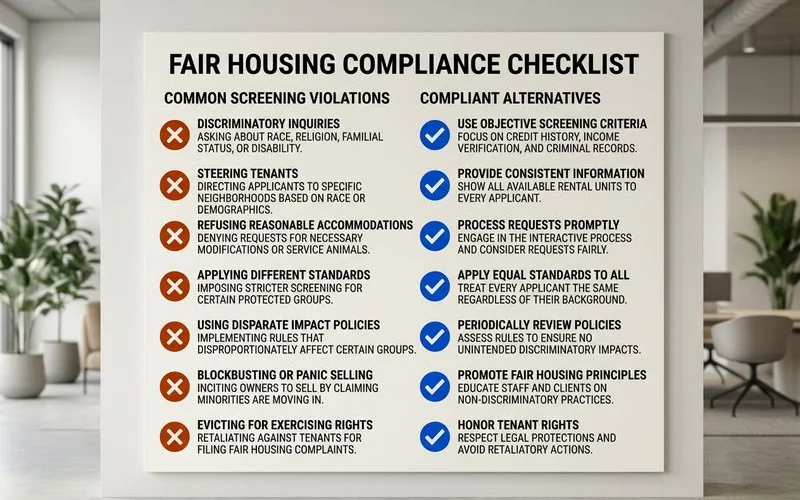
The Federal Fair Housing Act Protected Classes
We always remind owners that anti-discrimination laws operate on two levels. Federal guidelines protect applicants based on specific criteria. North Carolina enforces these same standards locally through the State Fair Housing Act, found under N.C. Gen. Stat. Chapter 41A.
The NC Human Relations Commission actively investigates complaints involving these federally protected classes:
- Race and color
- National origin and religion
- Sex
- Familial status
- Disability
Our property managers know that intent does not matter during an investigation. Criteria that unintentionally target a protected group can still result in disparate impact claims. You must ensure your application rules apply fairly to everyone.
We highly recommend reviewing your written policies annually to catch any accidental biases. A simple oversight in wording can trigger an expensive legal battle.
Seven Common Tenant Screening Mistakes NC Landlord Investors Make
1. Inconsistent Credit Thresholds
We frequently see independent owners accept an applicant with a 615 credit score just because they seem nice. Rejecting another applicant with that exact same score creates immediate legal risk. A strict, written credit threshold is absolutely required.
Our screening protocol relies on hard numbers instead of gut feelings. Data shows that inconsistent approvals leave you vulnerable to disparate-impact claims. Setting a firm baseline ensures every applicant gets a fair evaluation.
2. Blanket Criminal-History Bans
We urge landlords to stop stating they never rent to anyone with a criminal record. The Department of Housing and Urban Development issued clear guidance in 2024 addressing this exact issue. Blanket bans disproportionately affect minorities and violate the Fair Housing Act.
Our team performs individualized assessments for every single applicant. You must consider the nature of the offense and the time elapsed since the conviction. Focusing on recent crimes that threaten property safety is the compliant approach.
3. Source-of-Income Blanket Bans
We often catch owners mistakenly refusing to consider tenants with Housing Choice Vouchers. Source-of-income protections vary wildly across different municipalities in the state. In August 2022, Charlotte became the first city in North Carolina to implement strict protections for city-supported housing.
Our experts track these local ordinances closely to keep clients safe. A violation in Charlotte could result in fines reaching up to $115,000 for repeated offenses. You must verify local laws before rejecting an applicant based on their rental subsidy.
4. Occupancy Limits Below NC Standard
We strongly advise against arbitrary limits like two people maximum for a three-bedroom unit. Restricting space this way invites familial-status discrimination claims from families with children. The federal Keating Memorandum establishes a baseline standard of two persons per bedroom.
Our application process strictly adheres to this federal benchmark. Following this two-per-bedroom rule keeps you aligned with standard industry practices. Any limits below this threshold require a heavily documented, structural justification.
5. Asking About Familial Composition
We consider asking an applicant about their marital status or children to be a major mistake. Familial status is a heavily protected class under both state and federal law. You must focus your questions entirely on objective financial qualifications.
Our screening forms only ask for income data, credit history, and rental references. Sticking to verifiable financial metrics prevents accidental discrimination. Keeping the conversation strictly professional protects your business from unnecessary scrutiny.
6. Inconsistent Application Fee Handling
We notice many owners charge fees arbitrarily or offer refunds to select friends. This creates a scattered paper trail that falls apart during a legal challenge. You have to handle every single dollar the exact same way.
Our accounting systems process every fee with uniform precision. North Carolina law dictates that application fees are non-refundable by default. Standardizing your fee structure removes any appearance of favoritism.
7. Undocumented Decisions
We want to be clear that telling an applicant they are rejected over a phone call is a terrible idea. Verbal rejections offer zero defense against a formal discrimination complaint. You need a written rationale tied directly to your stated criteria.
Our managers send formal notices for every denied application. Putting the specific reason in writing stops arguments before they even start. Proper documentation is your absolute best shield against expensive lawsuits.
NC-Specific Application Rules
We ensure every property complies with state-specific regulations before accepting a single application. North Carolina does not place a statutory limit on how much you can charge for an application fee. The fee must simply reflect the actual, out-of-pocket costs of processing the background check.
Our team routinely sees typical screening costs in North Carolina ranging between $25 and $125. Charging a $200 fee when your credit pull only costs $40 will land you in legal trouble. You cannot use the application process as a hidden profit center.
We include all federally and state-mandated property disclosures right in the application. Specific notifications about lead-based paint for pre-1978 properties are completely non-negotiable. You must also disclose exactly which licensed bank holds the tenant’s security deposit.
Our managers always send a written adverse action notice if a denial involves credit information. The federal Fair Credit Reporting Act requires this document to list the specific credit agency used. Failing to provide this required notice triggers immediate federal penalties.
| Screening Component | Estimated Cost Range | Purpose |
|---|---|---|
| Basic Criminal & Eviction | $25 - $45 | Identifies past local infractions. |
| Comprehensive Credit Pull | $15 - $30 | Verifies FICO score and debt load. |
| Employment Verification | $10 - $25 | Confirms current income sources. |
| Full Application Package | $50 - $100 | Represents a legally defensible fee. |
Documentation That Holds Up
We always build a paper trail that can withstand a judge’s scrutiny. A defensible screening file serves as your primary armor against discriminatory tenant screening accusations. Every single applicant file must contain a standardized set of records.
Our document retention policy keeps records for at least three years to satisfy fair housing statutes. You must establish and date your written screening criteria before accepting the first application. The file needs the completed application and the official background check report.
We tie every single rejection to a stated rule in writing. Stating that an applicant was denied because their 612 credit score fell below the 635 threshold proves your objectivity. Your compliance file must include these six vital components:
- Written screening criteria established before marketing the unit.
- The original application with full applicant signatures.
- The screening report containing credit and criminal data.
- A written decision rationale tied to a specific metric.
- An adverse action notice if credit data influenced the choice.
- Proof of document retention for the period required by NC law.
How Professional Screening Reduces Exposure
We protect our clients by generating comprehensive documentation at every step of the leasing journey. The true value of a professional manager goes far beyond simply knowing the latest legal rules. A systematic workflow automatically builds the defense you need for any future challenges.
Our automated systems run every applicant through the exact same six-step pipeline. Every decision ties directly back to the written criteria we established on day one. Every file gets retained securely in the cloud to prevent lost paperwork.
“A consistent, documented workflow is the single most effective way to eliminate fair housing liability and ensure every applicant is judged solely on objective financial merits.”
We encourage owners to review how a fully compliant pipeline operates in practice. You can read about the specific steps in The Tenant Screening Process Explained. Seeing the workflow helps clarify where independent owners often miss crucial details.
Our team has also broken down the financial differences between handling this yourself versus hiring help. Review the cost analysis in our Self vs Professional Tenant Screening breakdown. A small upfront investment in compliance often prevents massive legal bills later.
We handle the entire operational burden for local investors who want peace of mind. You can explore exactly how our tenant placement service safeguards your rental income. This proactive approach keeps your property profitable and legally secure.
We provide this guide as general information rather than formal legal advice. Specific situations always require consultation with a qualified real estate attorney. Correcting these tenant screening mistakes NC landlord portfolios suffer from will shield your investments.