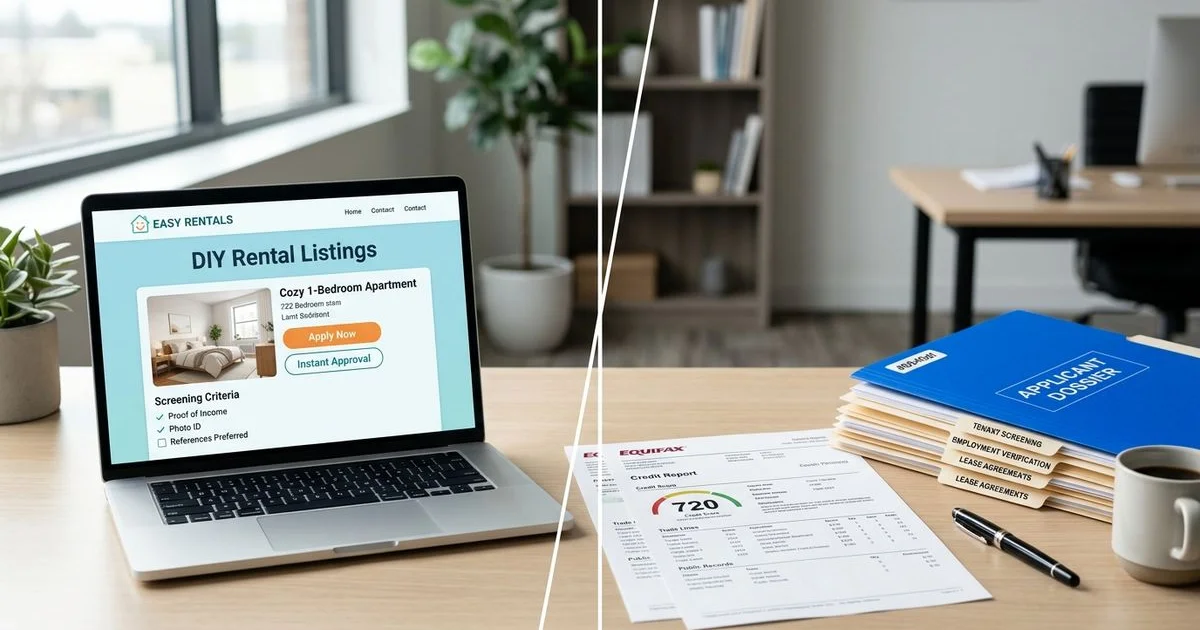
The gap between a shiny credit score and a truly reliable renter is getting wider across the US market. We know exactly how frustrating it is to sift through applications that look perfect on paper.
Fraud tactics are changing fast, moving from obvious lies to highly sophisticated fake documents. Our team at Durham Elite Property Management was founded to provide exceptional services that property owners can truly rely on.
Relying solely on automated data is incredibly risky today.
We will break down what standard software actually catches. Let’s look at the hidden risks that slip through the cracks. Our goal is to clarify the debate around self vs professional tenant screening, giving you practical ways to respond and protect your investment.
Self vs Professional Tenant Screening: What DIY Tools Actually Do
DIY tenant-screening tools (TransUnion SmartMove, Zillow Rental Manager, RentPrep) are certainly good products. Our team uses similar bureau-level data as a baseline for our own checks. They handle the initial credit pull and a basic background check quite well. The credit score, eviction-database flag, and basic public-record signals are auto-pulled and presented in a clean report.
We see many independent landlords assume an automated tool handles everything they need. The core difference in TransUnion SmartMove vs professional screening comes down to human verification. This specific ResidentScore metric is designed for the rental market, but numbers alone cannot verify truthfulness. Our screening process proves that even the best software misses behavioral red flags. If you are exploring RentPrep alternatives, know that almost all automated DIY options share the exact same blind spots.
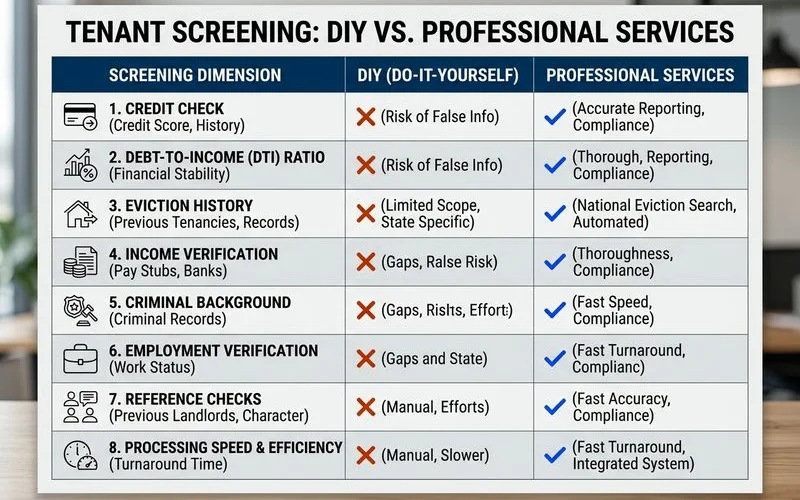
What DIY Tools Cover
Basic DIY platforms focus heavily on database queries to build their reports. We find that this essential coverage is decent for a single owner-occupied rental. The tools typically verify identity through standard data matching. Our analysis of the current market shows this is often enough for a low-stakes tenant pool. You get standard criminal database sweeps and national eviction registry checks.
| Dimension | DIY Tool |
|---|---|
| Credit score | ✓ Auto-pulled |
| Eviction history (database) | ✓ Auto-pulled |
| Basic public records | ✓ Auto-pulled |
| Identity verification | Partial (data-driven only) |
Recent 2026 data shows that late payment rates in independent US rentals climbed past 11 percent. We track these housing trends closely to understand where basic software falls short. This rising financial strain means basic coverage might not protect you from future defaults. Our recommendation is to view these DIY reports as a starting line rather than a finish line.
What DIY Tools Miss
The work that gets skipped by software is precisely the work that catches the most deceptive applicants. We consistently catch smart individuals who look perfect on a digital report but have glaring real-world issues. Software cannot detect when a previous landlord is giving a hesitant or carefully worded warning. Our human review process catches the nuances that automated forms completely ignore.
| Dimension | DIY Tool | Professional |
|---|---|---|
| Live employment call | ✗ | ✓ |
| Prior-landlord live calls | ✗ (form-fill only) | ✓ |
| Criminal-history individualized assessment | ✗ | ✓ |
| Income / DTI calculation | Partial | ✓ |
| FHA-compliant documentation | ✗ | ✓ |
| Adverse action notice handling | Partial | ✓ |
| Doctored pay-stub detection | ✗ | ✓ (via call) |
| Co-signer evaluation | ✗ | ✓ |
A 2024 report from Snappt found over 80,000 cases of manipulated rental applications. We are seeing a massive spike in document manipulation across the US rental market today. Independent property managers cite fake pay stubs as their number one fraud issue. Our staff routinely intercepts fake documents generated by websites like PayStubs.net. A DIY tool simply accepts these uploaded files at face value. We always mandate direct verification to bypass these sophisticated fakes entirely.
Real Cost of One Bad Tenant in NC
Accepting a bad tenant creates a cascading financial disaster for property owners. We warn our clients that the upfront savings of a $30 DIY check vanish immediately during an eviction. The legal fees, lost rent, and repair bills pile up much faster than most investors expect. Our property management experience shows that a single bad placement erases years of profit.
| Cost Item | Typical Range |
|---|---|
| Eviction filing + court fees | $200-$500 |
| Lost rent during eviction (2-3 months) | $4,000-$6,000 |
| Property damage above deposit | $1,500-$5,000 |
| Replacement marketing time | $500-$1,000 |
| Total per bad-tenant placement | $6,200-$12,500 |
Nationwide eviction filings topped one million cases recently, showing just how common this expensive nightmare has become. We also factor in the rising costs of property insurance and general maintenance in 2026. The total damage easily exceeds $10,000 when you account for the time your property sits vacant. Our professional screening prevents these placements and pays for itself many times over.
Live Employment Calls
The most diagnostic single signal in screening is a live employment call. We consider this step absolutely non-negotiable for protecting your investment. Doctored pay stubs are incredibly easy to make and very hard to detect on paper alone. Our property managers know that 85 percent of industry professionals have encountered falsified income documents recently.
Here is why a live phone call is so critical:
- Real HR contacts often share valuable signals beyond the formal “employment confirmed” statement.
- Tenure, position level, and likelihood of continued employment all surface in a quick 5-minute call.
- Fake references are easily exposed when you use a verified corporate directory instead of a provided cell phone number.
Relying on pay stubs alone is the default for DIY systems, and it misses all of this context. We use direct outreach to uncover the truth behind every single application. This proactive approach stops fraudsters before they ever sign a lease. Our team bypasses the risk by calling the employer directly using independent databases like The Work Number.
Prior-Landlord Conversations
Automated DIY tools typically just email the prior landlord a generic form to fill out. We find that bad tenants easily manipulate this step by listing a friend’s email address. Professional screening takes the time to actually make the phone call and verify property ownership. Our conversations dig deeper than a simple checkbox ever could.
| Question | Form Response | Phone Conversation |
|---|---|---|
| Did tenant pay on time? | Yes/No | Always paid? Late how often? |
| Property returned in good condition? | Yes/No | Specific damage? Held deposit? |
| Would you rent to this tenant again? | Yes/No | Why or why not? |
The phone version catches the polite but meaningful hesitation that a basic yes/no form misses completely. We listen carefully for the subtle pauses that indicate a hidden problem. This human element is the ultimate filter for protecting your rental property. Our trained staff knows exactly which follow-up questions to ask when a previous landlord sounds evasive.
FHA-Compliant Decision Documentation
Professional screening generates the essential documentation that defends your decision later on. We see too many landlords face legal trouble because they lacked written criteria established before the application. The decision rationale must be tightly tied to a stated criterion. Our compliance process includes sending proper adverse action notices whenever credit is a deciding factor. DIY tools simply do not generate this paperwork, meaning the landlord has to manually execute it perfectly every single time.
The 2025 National Fair Housing Alliance report shows that disability and retaliation complaints are surging right now. We keep a close eye on the rising number of housing discrimination claims across the US, specifically monitoring:
- Surges in retaliation claims
- Increased disability discrimination allegations
- Strict enforcement of proper adverse action notices
In North Carolina specifically, Legal Aid data shows over half of these recent complaints are concentrated in just five counties, including Durham and Wake. Our strict compliance standards ensure you are fully protected from these expensive legal disputes.
You can review the full failure modes that drive NC fair-housing complaints in Common Tenant Screening Mistakes That Get NC Landlords Sued. We highly recommend reading The Tenant Screening Process Explained to see the exact six-step pipeline our screening uses. The best way to avoid these exact pitfalls is to review our complete operational picture. We invite you to explore our tenant placement service for more details.
When DIY Is Fine
DIY screening absolutely makes sense for specific, low-risk situations. We often tell clients that a single owner-occupied rental with a familiar tenant pool is a prime candidate for basic tools. The landlord must be an owner who has the time, patience, and extreme discipline to apply consistent criteria. Our advice is to only use self-screening if you have a strong working knowledge of NC fair-housing rules and FCRA adverse-action requirements.
The equation changes quickly when your portfolio grows or your free time shrinks.
- Single owner-occupied rental with low-risk tenant pool
- Owner who has time, patience, and discipline to apply consistent criteria
- Owner with working knowledge of NC fair-housing rules and FCRA adverse-action requirements
A DIY approach demands constant vigilance to stay legally compliant. We know that when any of those critical factors break down, the math of self vs professional tenant screening tilts toward professional services fast. You gain total peace of mind knowing every applicant is vetted thoroughly and legally. Our property management solutions remove that burden entirely, so reach out today to protect your investments with expert screening.