
The Plain-English Scope of Property Management
We see exactly what goes through an investor’s mind when deciding whether to hire out daily operations. Handling the rental yourself seems straightforward until you ask what does a property manager do behind the scenes. The reality usually hits hard around month six.
Recent 2026 data from Found Spaces shows the average landlord spends roughly 53 hours a month tackling property issues.
Our team handles rent collection, maintenance coordination, tenant relations, financial reporting, and lease enforcement. Each function carries hidden challenges. Owners consistently underestimate this daily grind.
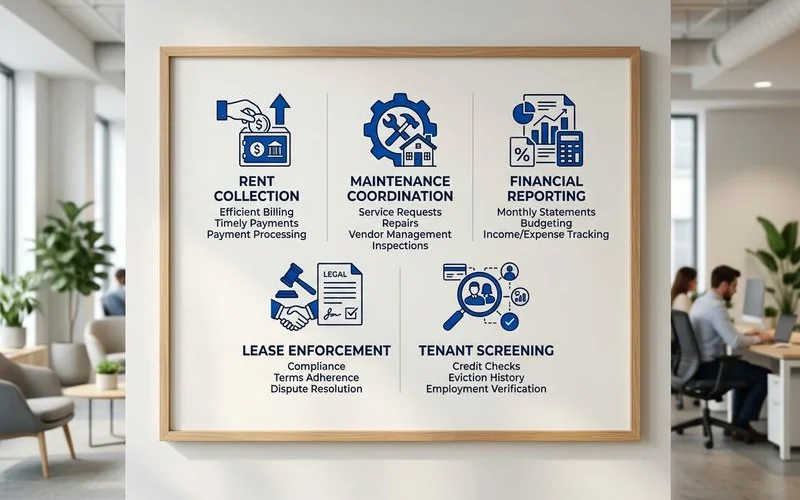
Our tenant placement and screening service handles the front end of this work. Linking back to our maintenance and inspections service gives you the full asset-protection picture. These two parts create a complete operational system.
What’s Included in Full-Service Management
Our full-service property management job description covers the complete lifecycle of your rental. The service removes you as the direct point of contact for every tenant problem.
Rent Collection and Financials
We process ACH-based monthly collections directly through the tenant portal. Automatic late-fee enforcement triggers according to your specific lease terms. Our accountants disburse funds to your owner account by the standard date each month. You usually receive this money by the 6th once funds clear.
We also generate your year-end 1099-MISC form for tax filing. This keeps your records organized for the IRS.
Maintenance Coordination
A 24/7 dispatch line takes the tenant call and triages the issue without waking you up. Vetted local contractors handle the necessary repairs. Our portal lets you see the actual invoices and photo documentation. An owner-approval threshold gates all non-emergency spending.
We require a network of trusted vendors to keep costs low. A 2026 report from TenantCloud shows the average property maintenance cost increased by 12% recently. This makes affordable, reliable contractors essential.
Tenant Relations
Our staff manages all lease questions and renewal conversations. Dispute resolution and complaint handling fall entirely on our shoulders. The day-to-day human contact turns a polite renter into a long-term resident.
A 2026 industry survey reveals the average cost of tenant turnover hits about $1,750 per unit. Retaining a good tenant saves you significant money. We prioritize clear communication to keep vacancy rates low.
Financial Reporting
Our reporting system keeps your accounting perfectly organized. You get full visibility into every dollar.
- Monthly statements: View collected rent and management fees.
- Maintenance invoices: Track vendor payments clearly.
- Net disbursements: See your final profit margin.
- Tax documents: Receive year-end preparation files.
Lease Enforcement and Evictions
Cure notices go out quickly for any lease violations. Smoke and carbon monoxide compliance follow-ups happen on schedule. Our team handles occupancy limits and pet rule enforcement. When needed, we escalate into the formal North Carolina summary ejectment process.
Filing an eviction in North Carolina Small Claims Court costs about $96 in standard filing fees, based on 2026 fee schedules. You also face additional service fees up to $50. We use the official AOC-CVM-201 Complaint form to file these cases correctly. Proper documentation prevents costly court delays.
What Property Managers Typically Don’t Do
Many owners ask what do property management companies do regarding large upgrades and taxes. The simple answer is that major capital improvements and personal tax filings remain the owner’s responsibility.
A few things land outside the standard scope and end up confusing investors. Capital improvements are owner decisions. We coordinate the work, recommend contractors, and oversee execution. The actual spend is yours.
Large projects like $5,000 roof replacements or HVAC system upgrades flow through your tax return separately. Tax preparation itself belongs to your Certified Public Accountant, not your manager. You must also file property insurance claims directly with your carrier.
HOA matters require a specific boundary. We coordinate with Homeowner Associations as your representative for tenant-affecting issues.
- Managing architectural approval forms.
- Handling common-area noise complaints.
- Processing tenant-related fines.
However, community management falls outside our scope. We do not run HOA boards or organize neighborhood meetings. That requires a completely different service line.
Property Manager vs Leasing Agent
The property manager vs leasing agent debate comes down to the length of the service. A leasing agent places one tenant and leaves, while a manager handles the daily operations for years.
These two roles are constantly confused because both involve placing renters. The difference is stark regarding daily involvement. A leasing agent places the tenant and walks away with a flat fee. This fee often equals 50% to 100% of one month’s rent based on 2026 market averages. Our property management team places the tenant and then operates the rental indefinitely.
We collect rent, handle repairs, enforce the lease, and replace the tenant when they leave. Most long-term residential managers charge a monthly fee between 8% and 12% of collected rent. You pay for ongoing peace of mind rather than a one-time transaction.
| Feature | Leasing Agent | Property Manager |
|---|---|---|
| Primary Goal | Fill a vacancy quickly | Maintain long-term property performance |
| Typical Cost | 50% to 100% of one month’s rent | 8% to 12% of monthly collected rent |
| Maintenance | No involvement | 24/7 coordination and vendor oversight |
| Rent Collection | No involvement | Monthly ACH processing and reporting |
| Legal/Eviction | No involvement | Files necessary court documents |
For a deeper comparison, see our Tenant Placement Only vs Full-Service Management guide. It walks through which service fits which owner profile.
A Day in the Life of Your Manager
A standard day involves resolving emergencies, fielding tenant calls, and preventing minor issues from becoming major expenses. We handle the chaos so you can focus on your actual career.
A typical Monday on a managed property moves fast. The tenant texts about a slow drain at 8:00 AM. Our coordinator triages the issue immediately. A vetted local plumber gets dispatched by 10:00 AM. You get a portal notification at 10:05 AM.
The plumber clears the line by noon. They upload photos and an invoice straight to the system. You see the resolved ticket before lunch without making a single phone call.
“Data from a 2026 TenantCloud survey shows 39% of property managers spend more than 20 hours a month just handling maintenance requests.”
This is the real value proposition in a single morning. We absorb that massive time sink. Maintenance markups typically run 10% to 20% to cover coordination. This small premium buys you access to preferred vendor pricing and immediate response times. You save money by preventing water damage from spreading.
When Self-Management Is Fine vs When a Manager Pays for Itself
Managing your own rental works if you have ample free time and only own one local property. It becomes a liability when your portfolio grows or you move out of state.
Self-management requires a strong working knowledge of local and federal laws. A single mistake can trigger massive penalties. The US Department of Housing and Urban Development (HUD) can assess a maximum civil penalty of $21,663 for a first violation of the Fair Housing Act. We stay updated on these regulations to shield your investment.
The DIY approach stops being practical when certain conditions break.
- You own more than two investment properties.
- Your rental is located more than 30 minutes from your home.
- A job relocation puts you completely out of state.
- A recurring late-rent pattern eats up your evenings.
For the explicit decision math, our DIY vs Professional Property Management for Durham Landlords guide lays it out clearly. We designed this resource to help you calculate your exact return on time. Understanding exactly what does a property manager do helps you evaluate your own schedule. Your time remains your most valuable asset.