
How to Tell You’ve Outgrown DIY
You know the exact feeling when a casual rental investment suddenly turns into a demanding second job. Most landlords don’t switch to a professional agency because of one dramatic, catastrophic event. Instead, the transition happens when a slow stack of daily friction finally becomes unbearable.
We built Durham Elite Property Management to provide exceptional services that local investors can truly rely on when this tipping point arrives.
A 2026 market report from Leasey.AI highlights that average management fees currently sit between 8% and 12% of collected rent. That cost looks entirely different when weighed against the stressful hours lost to middle-of-the-night maintenance calls.
Our team is going to break down the ten definitive signs you need a property manager to escape the DIY approach. These red flags act as a clear roadmap for your next operational decisions. Let’s look at the true cost of self-managing and walk through the exact break-even math to clarify your choices.
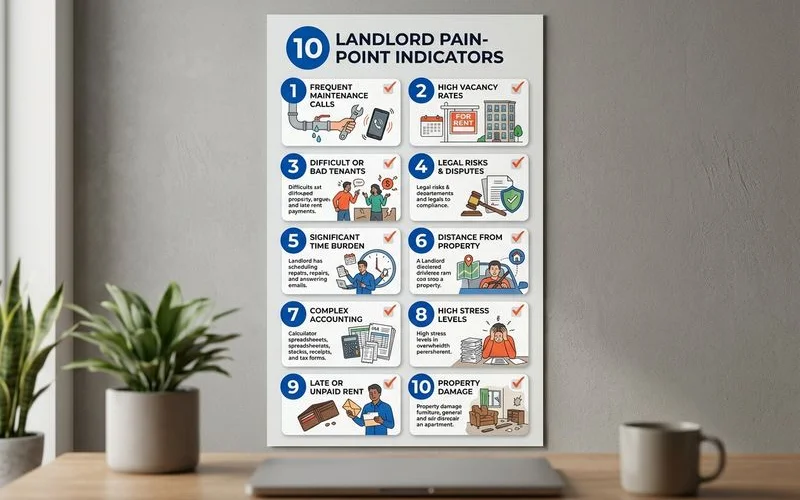
The 10 Signs You Need a Property Manager
Portfolio Expansion and Geographic Distance
1. You own more than two properties. Operational load scales nonlinearly in this industry. Two properties represent a manageable hobby, but four units quickly become a demanding part-time job. We see many ambitious owners hit a wall right around the third rental. Six properties managed solo is essentially a full-time job done poorly. Professional management typically pays for itself by property three or four, freeing up massive amounts of your personal schedule.
2. You moved away from the rental. Even 30 minutes of highway distance turns a quick fix-it call into a frustrating half-day commitment. An hour or more of travel turns routine vendor coordination into a logistical nightmare. Our local presence ensures that property checks happen quickly and efficiently. Remote owners frequently overpay for simple repairs because they cannot physically verify the work.
Financial Friction and Legal Liabilities
3. Late rent is recurring. Tenants who pay on day eight once are perfectly normal. Renters who consistently pay late every single month represent a severe screening miss. A 2025 Credaily report noted that late-payment rates in independently owned rentals rose to 11.7 percent. We utilize automated billing systems to handle collections without the emotional toll. The polite pressure required to collect these funds costs far more in mental energy than you might realize.
4. You’ve had an eviction (or are heading toward one). Data published by SmartScreen in 2026 shows the average eviction costs a landlord between $3,500 and $10,000. DIY evictions frequently fail in court based solely on procedural defects. Defective notices restart the entire legal timeline and lose you weeks of valuable rent. Our team processes these sensitive documents exactly to the letter of the law. Strict adherence to legal protocols prevents costly delays and gets your unit generating income again.
7. Your tax filing is a March scramble. Operating without segregated tracking of rent, maintenance, capital expenditures, and management fees creates chaos. Reconstructing twelve full months of financial activity under deadline pressure usually leads to missed deductions. We provide our owners with clean, standardized financial reports year-round. This level of organization saves you tremendous stress and significantly lowers your accounting bills.
9. You’re DIY-screening tenants. North Carolina fair-housing exposure carries immense financial risk for independent landlords. Applying inconsistent criteria to applicants invites discrimination complaints almost immediately. We apply a strictly documented rubric to every single applicant. The Department of Housing and Urban Development adjusted the maximum civil penalty for a first Fair Housing Act violation to $26,262 in 2025, making compliance non-negotiable.
Maintenance Lags and Personal Burnout
5. Deferred maintenance keeps surfacing through tenant complaints. When your renters are the first people to notice a problem, you are already falling behind. Unnoticed minor leaks quickly destroy drywall and subflooring if left unchecked. Our quarterly professional inspections catch these exact issues months earlier. Proactive maintenance preserves the physical asset and keeps your renters happy.
6. You haven’t raised rent in years. Self-managing landlords often skip annual rent reviews because the conversation feels uncomfortable. Renters stay longer, but the property slowly loses its competitive yield. We run detailed market comps and execute necessary increases with proper documented notice. Many independent properties sit 15 percent below current market value simply to avoid conflict.
8. You can’t take a vacation without checking your phone. When two weeks entirely unplugged feels impossible because of the rental, the property owns you. Your investment should generate reliable passive income, rather than daily anxiety. Our answering service handles the 2 AM emergency calls so you can actually enjoy your time off. A true investment works for your financial future without consuming your present.
10. You’re considering selling because management feels too hard. Selling a profitable rental strictly due to administrative fatigue forfeits years of potential appreciation. Holding onto the real estate is usually the smarter long-term wealth play. We step in to preserve the asset while completely removing the daily operational burden. Hiring a manager lets you retain the equity growth while walking away from the headaches.
What Each Sign Costs You
We calculate these exact financial drains daily for local real estate investors. The invisible toll on your personal time usually outweighs the hard monetary expenses. According to 2026 data from ClearLead Digital, tenant placement and leasing fees are easily offset by drastically reducing vacancy days. Every single day an empty unit sits on the market is money permanently burned.
| Friction Point | Average Financial Cost | Hidden Time & Stress Cost |
|---|---|---|
| Recurring Late Rent | Loss of cash flow predictability | 1-2 days of manual follow-up per month |
| Bad-Tenant Eviction | $7,000 to $12,000 in North Carolina | 2 to 4 months of court appearances and unit repairs |
| Deferred Maintenance | A $300 proactive fix becomes a $3,000 disaster | Emergency coordination during evenings or weekends |
| Vacancy Days | $66 lost per day (at $2,000/month rent) | Slower tenant placement yields a $924 loss over two weeks |
Our leasing process compresses that vacancy timeline significantly compared to the average homeowner. A structured approach keeps the revenue flowing and stops the bleeding on empty properties.
The Break-Even Math
We base our break-even math on real market figures. For a single $2,000 per month rental, an 8% management fee equals $160 monthly, totaling $1,920 for the entire year. This exact expense frequently stops independent landlords from seeking professional help. The reality of the balance sheet looks much different when you accurately account for risk mitigation.
A 2026 industry report from Benzinga confirms most management fees sit securely between 8% and 12% nationally. Professional screening alone prevents enough bad-tenant exposure to cover this annual base cost. Add five to seven fewer vacancy days per turn, which saves $330 to $462, and prevent one major capital expenditure surprise per year to save another $500 to $2,000.
Our financial analysis proves the math turns comfortably positive before you even calculate the value of your personal hours. Check out our DIY vs Professional Property Management for Durham Landlords guide for the complete cost breakdown. Analyzing property manager vs self management options is the best way to protect your real estate investment. Reach out to our team today to evaluate your portfolio and reclaim your free time.