From what I have seen, managing a rental property from afar is less about collecting rent and more about dreading a 2 AM phone call. That specific dread is a major reason independent real estate investors sell their portfolios.
At Durham Elite Property Management, we find that the single best feature of professional management for long-distance owners is 24/7 emergency rental maintenance. A midnight water leak quickly turns into a financial disaster if you sleep through the call.
Angi’s 2026 data shows water damage restoration in Raleigh averages a staggering $8,407.
Our team knows exactly why DIY landlords switch to this service. You need a buffer between your personal life and property emergencies.
Let us look at the data, what it actually tells us, and then examine a few practical ways to respond.
What 24/7 Maintenance Dispatch Actually Solves
A professional rental property maintenance dispatch service solves the costly delay between a tenant reporting an emergency and a contractor arriving on site. This system removes the landlord from the middle of a high-stress situation.
Our 24/7 dispatch line rings instead of your personal cell phone. Average emergency plumbing rates in the Raleigh-Durham area reach $150 to $300 per hour in 2026. Paying those inflated rates just to get someone to answer a weekend call drains your cash flow fast.
We bypass these premium, independent rates by utilizing a dedicated vendor network. A fast response provides three distinct financial advantages.
- Immediate triage without after-hours answering fees
- Pre-negotiated vendor rates instead of emergency surges
- Rapid on-site arrival to prevent secondary property damage
For example, catching a pipe leak early keeps your expenses far below that $8,400 local average for water damage restoration.
The Dispatch Flow
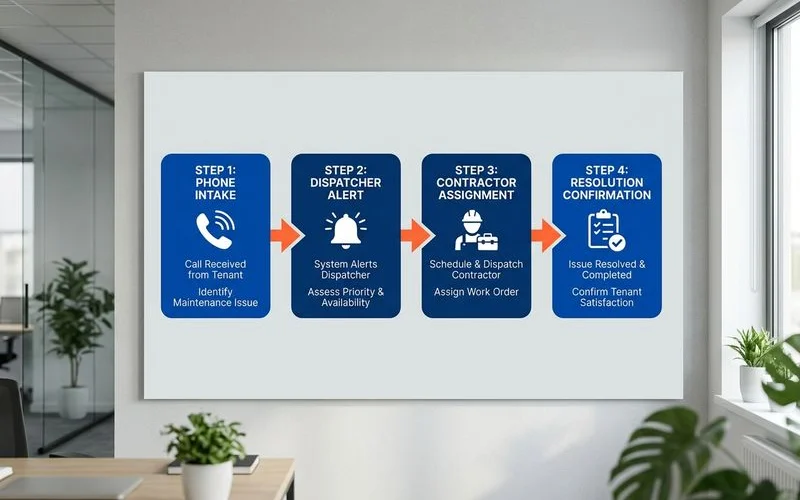
The dispatch flow is a structured, four-step process that moves a request from the tenant’s initial call to the owner’s final invoice review. A standardized approach prevents expensive after hours rental maintenance visits for minor, non-urgent repairs.
Our protocol ensures every issue gets handled with the appropriate level of urgency.
Step 1: Tenant Calls the Hotline
We instruct tenants to call the dedicated line rather than the property owner. The line remains open any time, any day.
We train residents on this specific communication process during their move-in orientation. This direct reporting prevents delayed action on critical problems.
Step 2: Professional Triage
The coordinator evaluates the problem to determine if it is a true emergency or a routine request. They identify the exact contractor specialty required for the job.
Our staff follows strict guidelines to separate a total heating failure from a mildly noisy air vent.
Step 3: Contractor Deployment
A professional from the vetted Triangle contractor network takes the assignment. Emergencies receive same-day service, while routine items wait for the next business day.
We require all these vendors to carry proper licensing and insurance. This standard protects your investment from unnecessary liability.
Step 4: Buildium Owner Notification
The system logs the issue directly into the Buildium owner portal for your review. You receive updates regarding contractor assignments, finished photos, and the final invoice.
Our system gives you complete visibility without forcing you to manage the actual logistics. You see the solution without coordinating the entire process.
Emergency vs Routine
Emergencies threaten tenant safety or cause immediate property damage, while routine issues are inconveniences that can wait for normal business hours. Proper classification keeps repair budgets under control.
We strictly categorize these requests to protect your financial returns. North Carolina General Statute Chapter 42 mandates landlords provide fit and habitable housing. Failing to fix a broken furnace during a winter freeze violates this specific state law.
Classifying Emergency Situations
Safety and property-threatening events require same-day action, often within a few hours.
We dispatch help immediately for these high-priority situations. A fast response is essential because mold can start growing on damp drywall within 24 to 48 hours in North Carolina humidity.
- Active water leaks or active flooding
- No heat in winter (temperatures below 50°F)
- No AC during a heat wave (temperatures above 90°F)
- Gas smells or known leaks
- Fire or smoke conditions
- Electrical hazards (sparks, burning odors)
- Sewage backups
- Major appliance failures preventing safe property use
- Lock-outs (typically same-day, often next-business-day)
Handling Routine Maintenance Requests
Our coordinators schedule non-safety issues for the next available business day. This delay avoids the $150 to $250 after-hours trip fee charged by most Raleigh tradespeople.
Our team groups these smaller tasks to improve vendor efficiency.
- Slow drains
- Worn weather-stripping
- Sticky doors
- Single non-essential light fixtures
- Cosmetic issues like paint scuffs or chips
- Loose cabinet hardware
- Single appliance issues not affecting immediate safety
Owner-Approval Thresholds
Owner-approval thresholds are pre-set financial limits that dictate when a property manager must get your permission before starting a repair. The management agreement clearly establishes this dollar amount.
We typically recommend setting this range between $300 and $500. Below this limit, the team authorizes the necessary work and uploads the invoice to your portal. Above the threshold, the coordinator pauses and contacts you for a final decision.
“Setting a firm $500 threshold ensures owners maintain control over large capital expenses while allowing property managers to handle routine fixes without constant interruptions.”
Our process prioritizes your financial control for everyday maintenance tasks. Safety emergencies override this limit to prevent massive property damage. A burst pipe requires an immediate water shut-off, which can cost $200 just for the emergency dispatch fee in Durham.
We proceed immediately to stop the flooding and notify you within minutes. The threshold exists solely for cost control, never to delay a critical safety intervention.
Typical Response Times
Response times vary based on the severity of the problem, ranging from 1 to 4 hours for active leaks to several days for cosmetic fixes. Triangle response times are generally tighter than rural North Carolina averages because our vetted contractors are centralized.
Our established network covers every major submarket to ensure rapid arrivals. Independent property owners often wait much longer for help. A 2026 HomeGuide pricing analysis indicates standard emergency plumbers might take up to six hours just to return a call during a weekend.
We bypass those costly delays with our dedicated vendor relationships. Here is a breakdown of expected response windows for common property issues.
| Issue Type | Response Window |
|---|---|
| Active water leak | 1-4 hours |
| No heat (winter) / No AC (summer extreme) | 2-6 hours |
| Lock-out | Same day, often within 4 hours |
| Sewage backup | 2-6 hours |
| Major appliance failure | Same day or next business day |
| Slow drain (non-emergency) | Next business day |
| Cosmetic issue | 5-7 business days, scheduled |
How the Vetted Contractor Network Handles After-Hours
A vetted contractor network handles after-hours emergencies by relying on established, long-term business relationships rather than random cold calls. Vendors answer the phone because they know the request comes from a reliable, high-volume partner.
Our coordinators can reach a trusted professional at any hour of the night. Plumbers and electricians face high overhead, so they frequently ignore vague requests from unknown callers at 11 PM. The contractor knows this dispatch is a real job, not a vague maybe.
“Contractors prioritize dispatches from established property management networks because the jobs are clearly triaged and payment is completely guaranteed.”
We guarantee their payment within standard terms, making us a preferred client. DIY landlords simply cannot replicate this reliability when dialing random repair services while out of state. Effective emergency repair coordination landlord services depend on these strong local connections.
The Buildium Owner Notification Flow
The Buildium owner notification flow pushes real-time updates to your device so you always know the status of a repair. Within minutes of a dispatch, you receive a detailed portal alert.
We ensure you see the initial tenant description and the official triage outcome. The alert also highlights the assigned contractor and the estimated response window.
Post-Repair Documentation
Our team requires contractors to submit comprehensive follow-up documentation. Once contractors finish the work, the portal updates with key deliverables.
- High-resolution photos of the completed repair
- The final, itemized contractor invoice
- A clear timeline summary of the dispatch
- Recommendations for future preventative maintenance
We close the visibility gap completely for long-distance owners.
For the inspection cadence that prevents many emergencies in the first place, see the Quarterly Rental Inspection Checklist. Annual budget planning is easier when you review the Annual Rental Property Maintenance Budget for North Carolina Landlords. For a complete view of the operational picture, explore our maintenance and inspections service.
Taking the Stress Out of Property Ownership
24/7 emergency rental maintenance transforms property ownership from a stressful second job into a truly passive investment. It protects your physical asset while preserving your personal time.
Our dedicated approach ensures you never have to wake up to a flooded kitchen or an angry tenant again.
A reliable dispatch system pays for itself the very first time a midnight disaster strikes.
We invite you to reach out today to discuss how professional property management can secure your investment.
Contact the team to learn more about setting up your rental portfolio for long-term success.